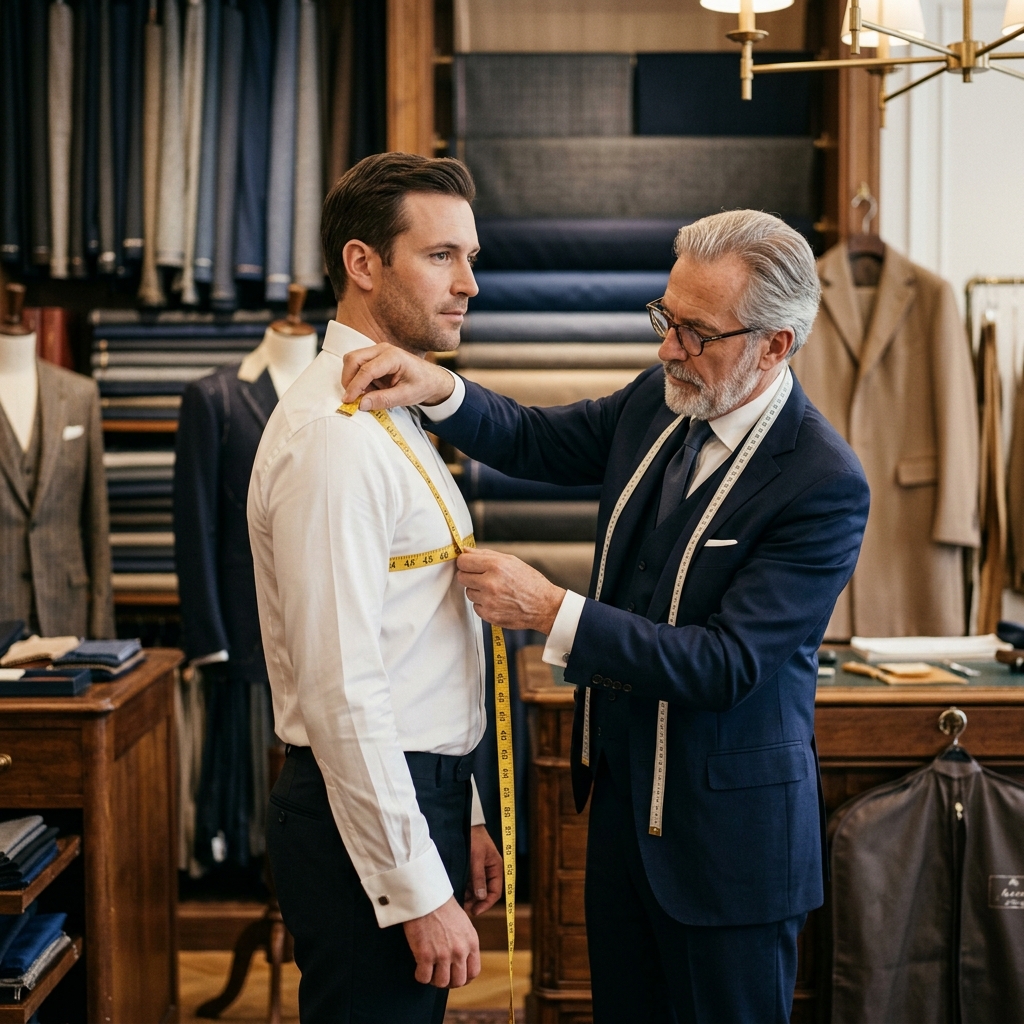
Imagine walking into an atelier where the first thing the tailor does isn't picking up a tape measure, but simply watching you stand. At Tanbir Style Zone, our 27+ years of experience in Kolkata have taught us that the most critical measurements for bespoke tailoring are often the ones the client never sees written down. It is the silent conversation between the master tailor's eye and the client's posture that defines the difference between a suit that simply fits and one that commands the room.
A true bespoke suit requires between 25 and 35 distinct measurements, ranging from core anatomical data like chest and waist to nuanced postural indicators like shoulder slope, arm pitch, and spinal curvature. These data points are used to draft a unique, hand-cut paper pattern—a process that distinguishes authentic bespoke from industrial custom tailoring.
The Philosophy of Precision: Why Every Millimetre Matters
In the world of luxury menswear, precision is not a luxury—it is a requirement. Standard ready-to-wear sizing relies on statistical averages, assuming that if your chest is 40 inches, your arms must be of a certain length and your shoulders must sit at a specific angle. Bespoke tailoring rejects this premise entirely. We recognize that every human body is a unique architectural puzzle.
At our Nagerbazar atelier, the measurement process is a diagnostic deep-dive. We don't just measure for size; we measure for character. Are you right-handed? Your right shoulder might be lower. Do you spend eight hours a day at a desk? Your posture likely leans forward, requiring a different balance in the jacket's back panel. These bespoke tailoring measurements allow us to compensate for these natural asymmetries, creating a garment that looks perfectly balanced on an asymmetrical body.
Furthermore, the way fabric behaves in Kolkata's humidity must be factored into every allowance. A measurement taken in a air-conditioned fitting room must account for the natural expansion of natural fibres when exposed to the external heat. This level of foresight is what separates a master tailor from a garment assembler.
Anatomical vs. Garment Measurements: The Hidden Logic
One of the most common misconceptions clients have is that the numbers on the tape measure are the numbers used to cut the fabric. In reality, we work with two distinct sets of data. First are the anatomical measurements—the raw physical dimensions of your body. Second are the 'garment measurements'—the actual dimensions of the finished piece, which include 'ease' for comfort and movement.
For example, if your actual chest measurement is 42 inches, cutting a jacket at 42 inches would leave you unable to breathe, let alone move. The 'ease' added depends on the style, the fabric's weight, and your personal preference. A sharp, executive 'power suit' might have a different allowance than a relaxed linen blazer intended for a summer wedding in Kolkata. Our goal is to find the perfect equilibrium where the garment follows the body's lines without restricting its movement.
We also pay close attention to 'pitch'—the angle at which your arms hang naturally. If a jacket's sleeves are set at a standard pitch but your arms hang slightly forward, you'll see unsightly ripples behind the sleeve. By measuring your natural arm pitch, we can rotate the sleeve head in the armhole, ensuring a perfectly clean drape from shoulder to cuff.
Comparison: Tailoring Measurement Depth
To understand the depth of data required for a true commission, consider how bespoke tailoring measurements compare to other levels of service:
| Feature | Ready-to-Wear | Custom / MTM | Bespoke |
|---|---|---|---|
| Measurement Points | Zero (Standard Sizing) | 8 – 12 Basic Points | 25 – 35+ Deep Points |
| Posture Analysis | None | Basic Adjustments | Comprehensive Diagnostic |
| Pattern Type | Standard Block | Modified Block | Unique Hand-Drafted |
| Asymmetry Correction | Impossible | Limited | Full Structural Compensation |
| Fittings Required | 0 | 1 – 2 Fittings | 3 – 4 Multi-Stage Fittings |
The Impact of Kolkata's Climate on Measurements
Kolkata is a city of extremes—the sweltering heat of May and the heavy humidity of the monsoon season. These environmental factors significantly impact how we approach measurements for bespoke tailoring. Natural fibres like high-grade wool, linen, and silk are dynamic; they breathe and react to the environment.
When we measure a client in our Nagerbazar atelier, we must anticipate this behaviour. A suit that fits 'skin-tight' in a cool room will become unbearable in 90% humidity as the body naturally swells and the fabric absorbs moisture. We calibrate the ease to ensure that even on the hottest day, your bespoke suit remains a comfortable haven. We often recommend open-weave 'fresco' wools or blends that provide the structure of a formal suit with the breathability of casual wear.
This local expertise is built into our heritage. Since 1998, we have dressed Kolkata's distinguished gentlemen, learning exactly how much room a trouser needs at the seat to allow for sitting through a long corporate event, or how the armhole height affects airflow under the jacket. These are not just numbers; they are lessons in comfort learned over three decades.
Posture, Balance, and the 'Stance' Measurement
Perhaps the most 'bespoke' part of the process is the balance measurement. Balance refers to the relationship between the length of the front of the jacket and the back. If you stand with a slight stoop, the back of your jacket will tend to hike up while the front drops. Conversely, if you stand very chest-out, the front will hike up. We measure this deviation precisely to ensure the hem of the jacket remains perfectly parallel to the floor.
We also measure the 'hollow' of the back and the prominence of the shoulder blades. Many men in Kolkata find that off-the-rack jackets bunch up behind the neck—this is usually a balance and posture issue that standard measurements cannot solve. By drafting the back-neck height and the shoulder-to-waist ratio specifically for you, we eliminate these unsightly rolls, creating a clean, professional silhouette that remains crisp even when you move.
Experience Precision Tailoring
Numbers are just the start. Let master tailor Tanbir Alam map your unique silhouette for a garment that truly fits your life.
The 4-Stage Bespoke Measurement Journey
At Tanbir Style Zone, we follow a rigorous sequential process to ensure every data point is captured with surgical accuracy. This isn't a rushed five-minute session; it's a 45-minute exploration of your personal style and physical form.
Step 1: Anatomical Mapping
We begin by capturing the fundamental dimensions of your body using a soft, professional measuring tape. This includes the chest (taken over the highest point), the natural waist (different from where you wear your belt), the seat, and full limb lengths from specific skeletal markers. These numbers provide the raw 'volume' of the garment and are the first entries into your permanent measurement profile at our atelier.
Step 2: Posture and Balance Assessment
Next, we move beyond the tape. The master tailor observes your natural stance from the side and back. We note the 'drop' of each shoulder, the curvature of the spine, and the natural 'pitch' of your arms. These observations are translated into specialized notations on your pattern—adjustments that allow the fabric to fall straight and clean regardless of your body's natural quirks or asymmetries.
Step 3: Movement Dynamics and Ease Calculation
A suit is a machine for movement. We ask you to sit, reach, and stand in your natural 'relaxed' state. We calculate the necessary 'ease'—the vital millimetres of extra fabric that ensure you can move comfortably without the fabric straining or losing its shape. This is where we discuss your preferences: do you prefer a sharp, 'skinny' look or a more traditional, comfortable drape? Your feedback here shapes the final pattern.
Step 4: Fabric and Environment Calibration
The final step is adjusting these numbers based on your chosen cloth. A heavy 14oz flannel behaves very differently from a 7oz tropical wool. We calibrate the final measurement tolerances based on the fabric's weight, weave, and breathability, specifically accounting for how the material will behave in Kolkata's humidity. This ensures that the 'fit' you feel during the first fitting is the same 'fit' you enjoy years later.
"Many people think a tailor's job is to measure the body. But a master tailor's real job is to measure the person's life within that body. A measurement session isn't just about inches; it's about understanding how a man stands when he's confident, how he sits when he's working, and how he breathes when he's comfortable. In Kolkata's heat, that extra half-inch of 'breath' in the pattern is the difference between a suit you wear and a suit you endure."
— Tanbir Alam, Master Tailor (27+ Years Expertise)
Conclusion: Investing in Your Unique Silhouette
When you choose measurements for bespoke tailoring at Tanbir Style Zone, you are moving beyond the world of 'close enough.' You are investing in a process that respects your individuality, your posture, and the specific demands of your lifestyle in Kolkata. Our 30-point measurement system is the foundation upon which we build your sartorial legacy, ensuring that every garment we produce is a masterpiece of fit and comfort.
Whether you are preparing for a high-stakes corporate meeting or a grand wedding celebration, the journey begins with a single, precise measurement session at our Nagerbazar atelier. We invite you to discover the confidence that comes from a garment that truly understands you. To begin your own bespoke journey, explore our complete guide to the bespoke process or visit us to see the craft in person.
Frequently Asked Questions
We recommend updating your measurements every 12 to 18 months, or whenever you experience a significant change in weight or fitness level. Even small changes in posture can affect how a bespoke suit drapes. At Tanbir Style Zone, we maintain a detailed measurement archive for all our clients, making it easy to recalibrate your pattern for your next commission at our Nagerbazar atelier.
For the most accurate measurements for bespoke tailoring, we suggest wearing a well-fitting dress shirt and trousers that represent your typical style. Avoid wearing heavy sweaters or bulky layers that might obscure your natural body lines. If possible, bring the shoes you intend to wear with the suit, as this helps us set the perfect trouser length and break, ensuring a sharp silhouette from head to toe.
Absolutely. One of the primary goals of our 27+ years of expertise is to use tailoring 'smoke and mirrors' to flatter the wearer's form. By adjusting shoulder padding, lapel width, and the jacket's button stance based on your specific measurements, we can make you appear taller, slimmer, or more athletically built. We use the internal floating canvas to create a structure that compensates for physical asymmetries, resulting in a cleaner, more confident appearance.
Yes, there is a profound difference. General tailoring measurements are usually limited to about 8 to 10 points and are used to adjust pre-existing garments. Bespoke measurements, however, involve a 30-point anatomical map used to create a completely new garment from scratch. This depth of data allows for much finer control over the drape, comfort, and longevity of the suit, which is why bespoke remains the gold standard of the craft at Tanbir Style Zone.
Measurements provide the blueprint, but fittings are where we build the structure. During a canvas fitting, we see how the fabric interacts with your body's movement—something a static measurement cannot fully predict. It allows us to fine-tune the balance and 'ease' in real-time. This multi-stage process is essential for ensuring that the final garment meets the high standards of bespoke excellence we have maintained in Kolkata since 1998.
Begin Your Bespoke Journey
Book a professional measurement session at our Nagerbazar atelier and discover the art of a perfect fit.